Showing posts with label New York City. Show all posts

Tuesday, December 20, 2011

Dyker Heights: Land of Lights and Also Horror.

Dyker Heights is an often pretty, sometimes hideous, largely Italian-American neighborhood in South Brooklyn. Its homes range from rambling, elegant Tudors to Scarface-inspired nouveau-riche Italianate monstrosities bedecked with stone lions. Seriously: there are more stone lions per capita in Dyker Heights than anywhere else in, well, I'm going to go out on a limb and say pretty much the entire universe.

Here in New York City, where detached single-family homes inspire awe in and of themselves, Dyker Heights has the added distinction of also being the most over-decorated neighborhood in the five boroughs. Its Christmas lights display is notoriously blazing and over-the-top, and I've wanted to go for pretty much the entire eight-plus years I've lived here. Finally, last night, I dragged my long-suffering husband down to Bay Ridge from whence we walked up to Light-Central: 83rd Street between 10th and 11th Avenues. This is what we saw:

Lights!

Jesus! And more lights!

Slightly creepy dancing dolls!


Trees bedecked with still more lights!


You know what's on this house? LIGHTS!


Ahhh... an understated, light-free house. Unless you count Jesus, light of the world as a light.

And then we found this:


Apparently these are called "Snow Babies" and they are tres Victorian. These particular sad death-dolls did indeed look at least 150 years old.


Passersby described this poor bear as variously "mangy" and "leprous." To that I am sure they all meant to add "frightening."


Though not quite as frightening as the Santa of Death. Incidentally, all these "Snow Babies" were moving. Slowly. And menacingly. As though they were after your soul. Which would make sense, since obviously their souls have long since been stolen and they are doomed to wander the earth forever...

A grand time indeed! Incidentally, did you ever stop to wonder what the deal was with all these crazy lights? Is it just a case of rich-person one-upmanship? Or are these people truly insane, like some sort of crazed, exhibitionistis anti-hoarders? Well, turns out there was a documentary made about these folks once upon a time; if you can get your hands on it, let me know. I'd like to see it. (The cast of characters includes a woman named Lucy Spatza, a.k.a The Plastic Queen. I am intrigued.)

Others posit a genuine cultural phenomenon at work here. In Italian Folk: Vernacular Culture in Italian-American Lives, author Joseph Sciorra posits the decorations may harken back to the agricultural rhythms of life in the old country as they serve to demarcate the seasons. Combined with an "enthusiastic embrace of American consumer culture" abundant Christmas decoration has become an "ethnically identifying practice and proclamation among New York's Italian-Americans."

Hence: giant animatronic Santa head! In the true spirit of Christmas, the uber-decorators are happy to share their lights with you and don't even mind if you traipse all over their lawns snapping photos. Which is very merry of them indeed.

Tuesday, December 6, 2011

From St. Nicholas to Santa Claus: By esteemed guest blogger Jared Goldstein!


December 6th is the Feast of Saint Nicholas. Not much is known about this feast day in North America, though many European readers will recognize this as a day when gifts are traditionally given to children. We in New York City are lucky enough to have had some jolly old Dutch forefathers, who brought the holiday with them.
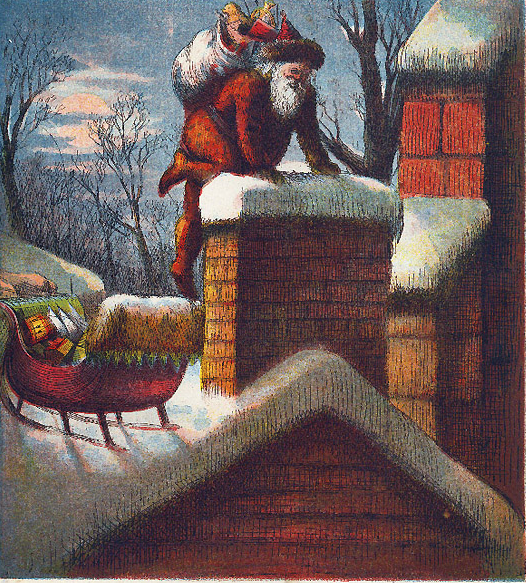
When the British took over the colony in the 1660s, their children envied the Dutch boys and girls who got presents every December 6th and begged their parents to follow suit. Then in 1823 Clement Clark Moore wrote the poem A Visit from St. Nicholas (otherwise known as "'Twas the Night Before Christmas") at his Chelsea estate. Finally, in the 1860s, German immigrant and cartoonist Thomas Nast popularized the image of Santa as a jolly fat man in the pages of magazines like Puck and Harper's Illustrated Weekly.


And thus St. Nicholas' journey from saint to Santa Claus was complete. That is my very basic understand of the subject.

But I know someone who knows much more about St. Nicholas, aka Sinterklaas, aka New York City's very own patron saint. Tour guide Jared Goldstein literally wrote the book on the subject: "Santa's Town: An Interview with Santa Claus about his New York City." So I'll shut up for a while and let Jared take over!


From St. Nicholas to Santa Claus: by Jared Goldstein

Saint Nicholas of Myra

Centuries ago there was a bishop in Asia Minor, St Nicholas, who anonymously paid dowries for poor maidens facing lives of degradation, since they could not get married without gold coins as was the custom then. Nicholas dropped coins in their stockings while were drying the night before they were to be turned out as prostitutes.

Since then he has been patron Saint of Children. One legend about him is that he was impatient during the day, whacking people with his bishops crook. Candy canes are the crook and red is the color of a bishop. Santa is both benevolent and strict!

Saint Nicholas is one of the few saints who is revered internationally by children, but also by musicians, men of the sea, and merchants. Most saints are local, venerated by a single religion or nation.

SinterKlaas

St. Nicholas’ fame spread to Holland, and his son SinterKlaas moved there, being the patron Saint of the international trading city Amsterdam. Children there leave out wooden clogs for his gifts, and he flies around with magic horses.

Over in Nordic and Germanic places this figure was a bit naughty and his sneaking into homes was not always nice. This Santa looked like a wood elf.

Washington Irving’s legend has it that SinterKlaas visited Nieuw Amsterdam in the 1600s, appearing in puffs of smoke. This was chronicled in Dietrick Knockerbocker’s History of New York, as interpreted by Washington Irving in the early 1800s. Nieuw Amsterdam would be a good place for SinterKlaas because it was the trading colony of Amsterdam.

Christmas riots

Christmas season in the 1700s lasted about a month, and it was rowdy fun for some. Those who worked on the farms would bang on the doors of their landowning bosses and demand grog and figgy pudding, which have a lot more alcohol than figs. The drunken workers would sing songs and leave.

Some of the young men would bang on pots, making noise, and breaking into stores, stealing things. Nieuw Amsterdam was New York City by then, one of the most diverse places in the world.

Christmas was like a month long Halloween Mischief Night with Treats and being naughty and nice, until Santa came to town.

Santa Claus

John Pintard was a great American. He founded the first life insurance company, fought bravely in the Revolutionary War as a young man, and he wanted America to have things to be proud of as a new nation, the world’s first new nation.

Thank John Pintard for Independence Day, President’s Day, and Veteran’s Day. He also founded the New York Historical Society in 1806. He believed in the power of symbols and story-telling to unite people into a nation.

In 1810, the winds of war with Britain were blowing again, which would become the War of 1812.

So many newcomers from around the world had been pouring into the fast-growing NYC. Few had any idea that our city was different than every other American city, because it started as a Dutch colony, not a British colony.

John Pintard wanted to show we were different than the British that we were going to war with again. The British saint is St George. New York declared SinterKlaas to be our patron Saint since the days of Nieuw Amsterdam.

John Pintard invited SinterKlaas to live in NYC, but the elderly Klaas sent his young son, Santa Claus, which is American for SinterKlaas, to live in NYC. At first he was hailed as Sancte Claus.

Santa was brought here to be patriotic!

Pintard printed pictures of the Saint with a poem, and declared him the friend of good children, who got gifts, or by giving parents a switch to whip bad children.

Santa brought unity to Christmas. Instead of people rioting on Christmas, they were home for Santa Claus, many buying their gifts before St Nicholas Day or Christmas Eve to be ready.

Santa = Patriotism, Peace, and Prosperity!

Also attending the Santa Claus Birthday Dinner on Dec 6, 1810 was Washington Irving who wrote the humorous history of Nieuw Amsterdam from the point of view of the Dutch-American New York Knickerbockers who venerated SinterKlaas. Irving wrote other Christmas stories about family-oriented Christmas celebrations (instead of rioting).

Also, Clement Clark Moore, who 12 years later wrote “A Visit From St Nicholas,” which begins with: ‘Twas the Night Before Christmas, and all through the house, not a creature was stirring, not even a mouse.”

This poem solidified the main holiday to Christmas Eve and Christmas Day. People would celebrate Christmas from St Nicholas Day through early January.

The poem encouraged Clarke’s naughty children to behave. His poem was the first to describe the Magic Reindeer, although illustrations from 1821 depicted them.


To learn more about Santa's history, visit Jared's website. The man does Santa-themed walking tours! Who wouldn't love that?